Friday, September 27, 2013

Welcome Fall - Goodbye Conrads

Bixby, Oklahoma  - Tess Maune, News On 6 (read the original story here)


A farm that's been bringing Green Country fresh produce for more than seven decades is closing. Conrad Farms in Bixby is set to close October 2, 2013.


For decades, people have been taking home a piece of the farm, like its famous corn. But now, the whole farm is on the market and the farmland there may never look the same.
Conrad Farms includes a market stocked full of homegrown goods, the kind of produce that's never seen a highway or a long road trip.


"It's picked across the street and they bring it over here. Can't beat that," said Tulsa resident Sherry Brodsky. "I don't have my own garden, so I let them do the gardening."
Conrad Farms has been doing the gardening since 1941. That's when Chester Conrad bought a little land that's been feeding the community ever since. "A horse and 13 acres, I think, Dad bought down here," said the farm's co-owner Vernon Conrad.


Over time, 13 acres grew to nearly 200, plus another 200 acres that the Conrads lease.
Vernon Conrad and his two older brothers, Eugene and Melvin, have been running the family business for years. But as Vernon says, he and his brothers aren't getting any younger, so the family decided to give up the farm and all the hard work it requires. The land has been used to grow produce for the past 71 years, but now that it's up for sale, it may never serve that purpose again.


Vernon said there are several interested buyers, who would like to put in housing additions on the property. "It's all in the city limits of Bixby and it's above flood stage. It's ideal for houses or houses with a garden or whatever," Conrad said.


It's a heartbreaking thought for the many loyal customers.
"That's sad, I'll have to stock up, because there's no place like this anywhere near here," said Bixby resident Jeana Horseman.


But with the ending of an era, comes the beginning of a much-deserved break for the Conrads."I'm going to go fishing first, then go on a vacation and then watch football," Vernon said.Conrad didn't want to get into how much the property is going for, but he said the chances that it will ever be used for farming are slim.There is a younger generation of Conrads, but Vernon said none of them were interested in the dirty, sweaty business of farming.


Too bad...this longtime Conrad's shopper will miss you very much!
Ahh...the dynamics of life... change is certain.
Here's wishing you Happy Fishing, Vernon!!

Sunday, September 22, 2013

Context - Food for Thought

 
Eating high glycemic foods, namely refined carbohydrates that digest quickly and represent a big, instantly-available caloric load, tends to raise inflammatory markers in the short term. Again, if you’re munching chips or white bread while sitting on the couch and the only walking you’ve done all day is to the pantry, those high glycemic foods will be inflammatory (to say nothing of the anti-nutrients in the bread or the rancid vegetable oil in the chips). And if you do the same thing on a regular basis, they will induce systemic inflammation – or at least continuous acute spikes that mimic systemic inflammation. If you’re eating a fast-digesting, high-glycemic white potato after your glycogen-depleting sprint workout, you will refill your insulin-sensitive muscles and the subsequent inflammatory spike will be either nonexistent or nothing to worry about.

Competitive athletes probably thrive on high glycemic foods, couch potatoes develop metabolic syndrome eating the same things. Context.


Wednesday, September 18, 2013

The Hedge Apple's are Making

Bumper crop of hedgeapples in OK and KS this year!!


Hedge Apple's are on the ground!!

The Osage Orange Tree and the Hedge Apple.


 J. D. Burton wrote - The Osage Orange tree (also known as a Bodark tree) produces no sawtimber, pulpwood, or utility poles, but it has been planted in greater numbers than almost any other tree species in North America. Osage-orange was planted in great numbers, first as a field hedge, before barbed wire became available, secondly as a windbreak and component of shelter belts, and thirdly to stabilize soils and control erosion.

There was once estimated to be over 250,000 miles of Osage Orange hedge rows such as this. No other wood played such an important part in the early movement west of the settlers as the Osage Orange. It provided the necessary means to divide land and contain livestock. As it grew the branches were intertwined to make the hedge almost impenetrable by animals
as well as man. These "sharp as needle" thorns aided greatly to the fence effect as did the  quick growth of this species. Some say barbed-wire was modeled after this ferocious tree. 


Osage-orange heartwood is the most decay-resistant of all North American timbers and is immune to termites. The branch wood was used by the Osage Indians for making bows and is still recommended by some archers today. James Easter, Bowyer still handcrafts primitive bows from Osage-orange wood. Below is a photo of Easter's Osage-orange wood staves drying for bow making.


Dried Osage-orange heartwood is one of the highest in BTU's when used as firewood. According to Hedgeapple.com, "There is an person in Americus, Ks who makes Harps from Osage Orange because he believes it is the most dimensionally stable of all woods when aged and placed under strain."

Additionally, some believe the chemical properties of the fruit, seed, roots, bark, and wood may be more important than the structural qualities of the wood. A number of extracts of actual and potential value in food processing, pesticide manufacturing, and dye-making have been identified by researchers, but they have not yet been employed by industry.  

Now, about the HedgeApple...
Larger than a grapefruit and knobby to boot , the fruit of Maclura pomifera (cousin of the Mulberry tree) — known as the hedge apple or horse apple, turns yellowish-green when it ripens in the autumn. It also develops an aroma faintly like an orange (hence the name Osage Orange), but it certainly doesn't taste like an orange.


Some folks will tell you that Hedge Apples are poisonous, others will tell you this has been proven not to be true in university studies, and that this belief stems from old tales of farmers finding dead cattle or horses with hedge apples in their mouths. New research contends that  these animals died of suffocation and not poison. Others will tell you that deer and squirrel do munch the hedge apple.

Lots of folks swear by the hedge apples insect-repellent properties. Some folks just put them around whole, while others recommend cutting them up and putting them in a container before setting them around. They do contain a milky white sap that can be messy, but according to some folklore, that is what repels the crawling critters.


But the most interesting thing I have found is from Mullins Log Cabin in Berry, KY. under the heading on their website titled: Hedge Apples & Cancer. These folks convey stories of people who have reportedly used hedge apple to kill cancer cells in their bodies, by way of a chemical found in hedge apples known as Tetrahydroxystilbene. Judy Mullins states she freezes the hedge apples and then grates what she wants to consume each day. She says they taste a bit like cucumbers to her, but maintains some people don't like the taste and recommends putting the shredded hedge apple in a gelatin capsule for those folks.


I found another website, The Racehorse Dispensarywhere the author maintains, "Modern researchers are scrutinizing many of the compounds in the Osage Orange.  One of the active compounds is Tetrahydroxystilbene (THS) which shows significant anti-fungal activity and probably is the one we are most interested in. It is also known as a Resveratrol analog. That name may ring a bell with some. A phytoalexin present in grapes, peanuts and pines  that has antioxidant and anti-inflammatory activities. The TV show, 60 Minutes did a piece on this exciting new compound as featured in wines a few years ago. There continues to be quite a bit of research done on THS. One will find this wonderful substance in the Osage Orange and at much higher levels than can be found in red wine!

I think I find these hypothesis so very interesting because of my desire to have a more holistic approach to medicine. In the last ten years I have observed several extended family members and friends battle and many succumb to cancer, despite traditional treatments like chemotherapy. I feel we may be doing ourselves a disservice in overlooking the old-time natural approach to medicine. Just food for thought.

Sunday, September 8, 2013

ASPARTAME - A TIP FROM NATURE

According to Wikipedia, the artificial sweetener aspartame has been the subject of several controversies since its initial approval by the U.S. Food and Drug Administration (FDA) in 1974. The FDA approval of aspartame was highly contested, with critics alleging that the quality of the initial research supporting its safety was inadequate and flawed and that conflicts of interest marred the 1981 approval of aspartame. In 1987, the U.S. Government Accountability Office concluded that the food additive approval process had been followed properly for aspartame.

Potential health risks have been examined and dismissed by numerous scientific research projects. With the exception of the risk to those with phenylketonuria, aspartame is considered to be a safe food additive by governments, worldwide, and major health and food safety organizations with FDA officials describing aspartame as "one of the most thoroughly tested and studied food additives the agency has ever approved" and its safety as "clear cut". The weight of existing scientific evidence indicates that aspartame is safe as a non-nutritive sweetener.

Okay,,,maybe the potential health risks have been examined and dismissed by numerous scientific research projects...however, I will put my faith in Mother Nature's research every time. 


Looks like these ants have a different opinion about Aspartame.

A KILLER IN YOUR FRIDGE

SWEET POISON….A MUST READ!!!

I will explain why Aspartame is so dangerous: When the temperature of this sweetener exceeds 86 degrees F, the wood alcohol in ASPARTAME converts to formaldehyde and then to formic acid, which in turn causes metabolic acidosis. Formic acid is the poison found in the sting of fire ants. The methanol toxicity mimics, among other conditions, multiple sclerosis and systemic lupus.

Many people were being diagnosed in error. Although multiple sclerosis is not a death sentence, Methanol toxicity is!

Systemic lupus has become almost as rampant as multiple sclerosis, especially with Diet Coke and Diet Pepsi drinkers. The victim usually does not know that the Aspartame is the culprit. He or she continues its use; irritating the lupus to such a degree that it may become a life-threatening condition. We have seen patients with systemic lupus become asymptotic, once taken off diet sodas.

In cases of those diagnosed with Multiple Sclerosis, most of the symptoms disappear. We've seen many cases where vision loss returned and hearing loss improved markedly.

This also applies to cases of tinnitus and fibromyalgia. During a lecture, I said, 'If you are using ASPARTAME (Nutra Sweet, Equal, Spoonful, etc.) and you suffer from fibromyalgia symptoms, spasms, shooting, pains, numbness in your legs, cramps, Vertigo, Dizziness, Headaches, Tinnitus, Joint pain, Unexplainable depression, anxiety attacks, slurred speech, blurred vision, or memory loss you probably have ASPARTAME poisoning!' People were jumping up during the lecture saying, ’I have some of these symptoms. Is it reversible?' Yes! Yes! Yes!


Continue reading this article here


For some independent research...

Self-Funded Study Found HUGE Tumors from This Everyday Food...

Victoria Inness-Brown conducted a personal two and a half-year experiment on the effects of aspartame, probably the worst of the artificial sweeteners on the market.
Her experiments resulted in the book, My Aspartame Experiment: Report from a Private Citizen, as well as the shorter summary version Are Your Diet Sodas Killing You? Results from My Aspartame Experiment 

Read more about this experiment here.

As for me...I'm with the ants!!

Thursday, September 5, 2013

Happiness

Happiness is like jam, you can't spread even a little without getting some on yourself. --Vern McLellan

The Business 9 Women Kept A Secret For Three Decades

--by Lori Weiss, syndicated from huffingtonpost.com, Jun 29, 2012
Somewhere in West Tennessee, not far from Graceland, nine women -- or "The 9 Nanas," as they prefer to be called -- gather in the darkness of night. At 4am they begin their daily routine -- a ritual that no one, not even their husbands, knew about for 30 years. They have one mission and one mission only: to create happiness. And it all begins with baked goods.
 
“One of us starts sifting the flour and another washing the eggs,” explained Nana Mary Ellen, the appointed spokesperson for their secret society. “And someone else makes sure the pans are all ready. We switch off, depending on what we feel like doing that day.
“But you make sure to say Nana Pearl is in charge, because she’s the oldest!” she added with a wink and a smile.

Read the Story

Tuesday, August 20, 2013

It's Persimmon Time Again


http://www.eattheweeds.com/newsletter-16-january-2012
We were at a small wooded park the other day, letting our pooch run about, and came across five trees with little pumpkin-looking fruits. I knew these little fruits looked familiar, but thought, "Hmmm...not sure what that is."

Hub says, "I don't know what they are either, but those look like hickory trees". I quickly asked, "What makes you think they are hickory trees?" Hub replies, "Well, everything about them, the bark, the leaves...". My reply "Oh, okay."

Once home, a little research revealed a surprise. Imagine hub's chagrin when I told him to call Guinness because we found some hickory trees that were growing persimmons. I do love my hub, he is so entertaining sometimes, and hey, we have to take our entertainment where we find it, right. (Below are the two of the photos I took that day.)


Not really surprising, under the trees were three piles of deer poo (persimmon seeds included)...which I took as an indication that deer must like to munch the wild persimmons.

http://inmykitchengarden.blogspot.com/2009/10/garden-journal-103109-happy-halloween.html

According to local native folklore (which means it hasn't been scientifically proven, or disproved), the severity of approaching winter can be forecast by cutting open a persimmon seed and looking at the shape of the kernel inside. Hold the seed carefully with a pair of needled-nose pliers and use a paring knife to slice it open.

If the kernel is spoon-shaped, lots of heavy, wet snow is the forecaste. If the kernel is fork-shaped, powdery light snow and a mild winter is predicted. If the kernel is knife-shaped, the prediction is for icy and bitter cutting winds.

I grew up with this folklore and Mom shared a story of how, when her and my uncles were kids, the wild persimmon was what they would try to get a kid who didn't know what they were to eat, while still firm (unripe) for the biggest pucker face ever. These little wild fall fruits must be soft and mushy to be fit for consumption and they are very heavy on seeds. It would take quite a lot for any significant amount to make pudding or cookies.

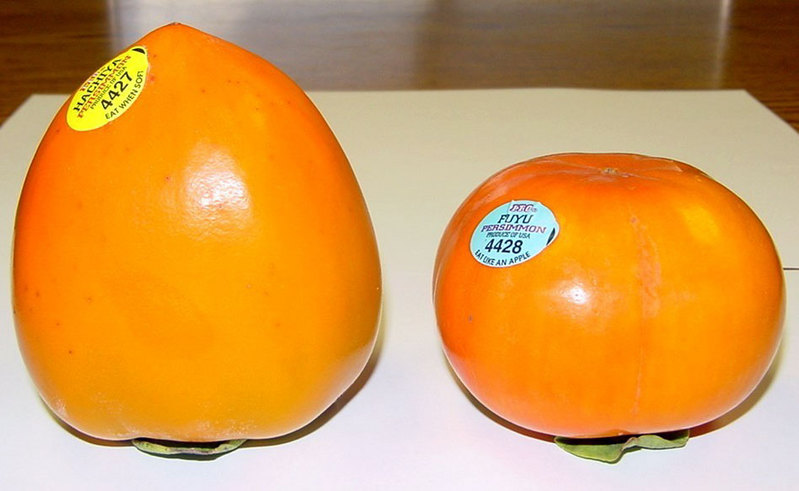
However, in the produce department at the grocery store I found the Fuyu and the Hachiya persimmons. Wow! This picture shows how small the wild persimmons are alongside the Fuyus.

http://www.reallyrawfood.com/2008/11/16/wild-persimmons-vs-fuyus/

Fuyu persimmons are the squatty looking ones. They are best when they are reddish orange and firm to the touch. You can eat Fuyus when they're crunchy and they taste mild and sweet. The Hachiya persimmons are sort of shaped like a cone and can't be eaten until they are extremely soft. They're good for smoothies and for baking. The Hachiya persimmons need to be totally soft before eating because they are highly astringent and will make your mouth pucker. Not a pretty mouth feel or sight!

http://bikinirun.blogspot.com/2010/12/playing-with-persimmons.htm

Persimmons are a great source of fiber, vitamin A (as beta-carotene, ergo the beautiful orange color), and give us a decent amount of potassium, vitamin C and vitamin E.


Tried this recipe for persimmon salad and boy was it tasty!

Persimmon Salad
Salad Ingredients:
*1 - 6 ounce bag baby spinach
*3 medium Fuyu persimmons, cored and cut into slices or cubes
*1/4-1/2 cup roasted pecans
*1/4 cup dried cherries (or dried cranberries if you can't find the cherries)

Dressing Ingredients:
(this dressing is easy to make but if you really don't have time any citrus flavored store bought one will work too)
*2 Tbs. Seasoned rice vinegar
*3 Tbs. Olive oil
*3 Tbs. Orange juice
*1/2 tsp. Salt

Directions:
Mix dressing ingredients well. Toss salad ingredients with dressing just before serving. It's as easy as that!


Below are additional links to persimmon recipes. 

Persimmons are around for such a short time. Take advantage of this delicious fruit with one of these persimmon recipes and enjoy.

Monday, August 19, 2013

Time for Sand Plums


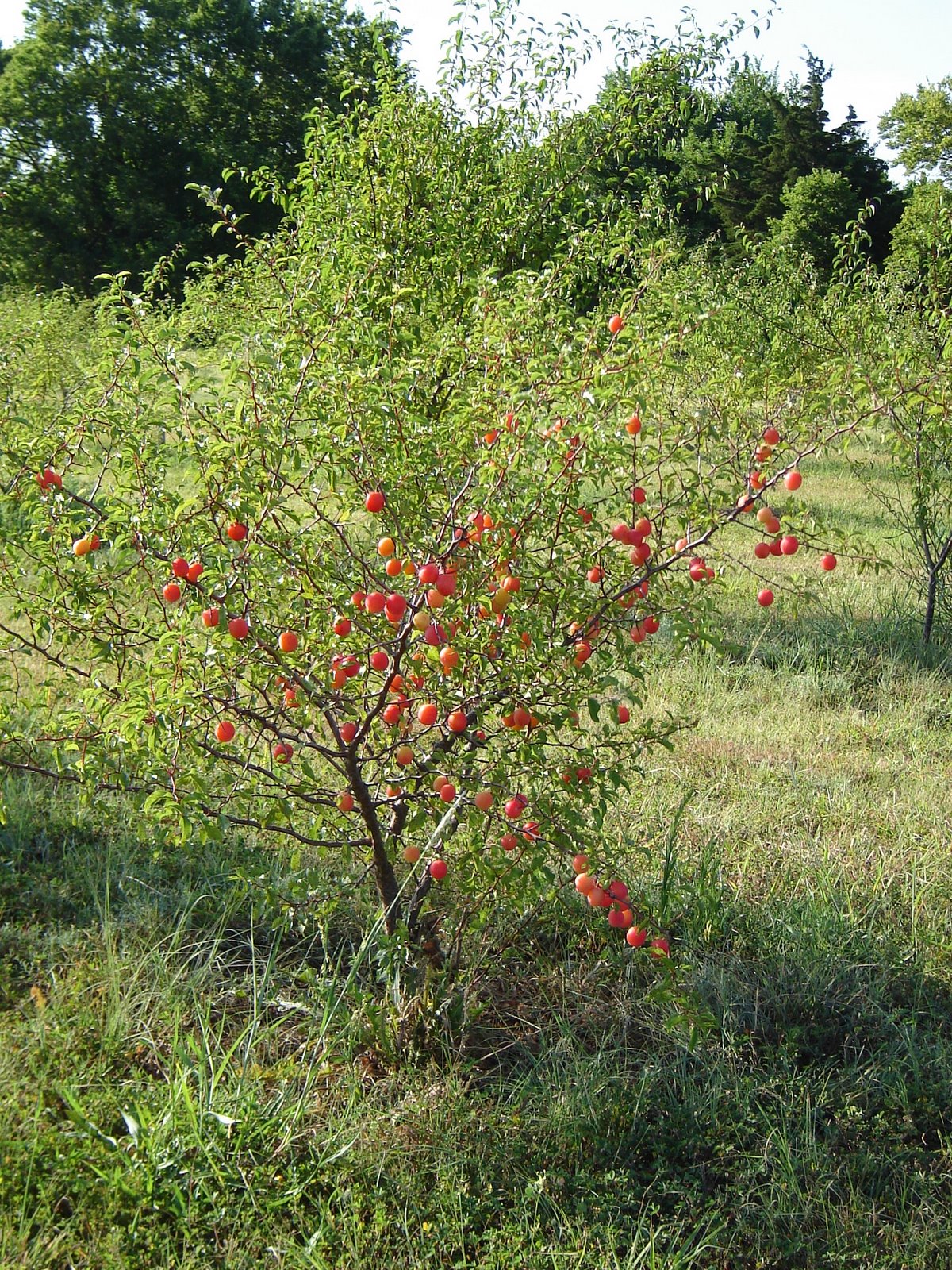
The Chickasaw, Cherokee or sand plum grows 12 to 20 feet tall and 15 to 20 feet wide in an irregular shape. It is "twiggy" in nature, and has a scaly, almost black bark. Its branches are reddish with a thorn-like, small side branches. In February, March, April and May, small white flowers blossom, 8–9 mm wide, along with red plums, up to 25 mm long. The flowers have five white petals with reddish or orange anthers. The plums ripen in late summer. It is perennial and also an evergreen. It requires low to medium amounts of water to grow, and dry, sandy or loose soil. It grows best in areas with regular sunlight or areas of partial shade. In sunny areas, it will be more dense and colonize more thickly. In areas of partial shade, it will be thinner and less dense, and each plant will be more spread out.


http://theworkofherhands.wordpress.com/category/food/sand-plums/
Prunus angustifolia or sand plums are native to the United States and can be found in all of the central plain and southern states, as well as California. They grow in dry and sandy soils, such as open woodlands, woodland edges, forest openings, savannahs, prairies, plains, meadows, pastures, and roadsides. Chickasaw plums tend to bloom early in the spring. Because they bloom early in the spring, before many other plants bloom, and require very little maintenance, they are often used in horticulture for ornamental use. They are found along many highways, especially in the southern part of the United States. The fruit is eaten by various animals. It also provides cover for nesting sites. Ripe fruits are slightly tart, but can be eaten or are sometimes made into jellies, desserts and preserves. Because of its attractive bark, small leaves and thin branches, Chickasaw plum is also sometimes used for bonsai.


Use of sand plums range from cover for native bird species to making jams, jellies, and wine from the fruit. Commercial desire in making jams and jellies has led to a rising interest in cultivating sand plums for home and orchard production. Sand plums range from 2 feet to 25 feet high, depending upon soil and water conditions. Leaves are bright green and have serrated edges that have tiny orange dots on each serration. The leaves have a slick feeling to the touch. This characteristic can help distinguish it from Oklahoma Plum, which looks very similar but has leaves that are fuzzy to the touch.

The bark is initially a deep reddish brown color that turns ash gray as the branch ages. Flowers typically appear in March to early April and are arranged in clusters. These flowers are a brilliant white and may have a faint fragrance. They usually are no bigger than 0.5 inches across. Flowering will last for a couple of weeks and either red or yellow fruit will begin to form afterward. Ripening of the fruit occurs from June to early August and are either yellow or a bright red. Both colors occur in the same areas of Oklahoma. Fruit size can range from ¼ inch to 1 inch. It is recommended that long sleeves be worn while collecting fruit since the plants may be thorny, depending upon how damaged they have been by deer and cattle in the past.
Sand plum recipes can be found on the web for all sorts of delicious goodies like jelly, jam, butter and bread. Here are links to just a few...
Sand Plum Jam
The sand plum season is short...enjoy some today!